
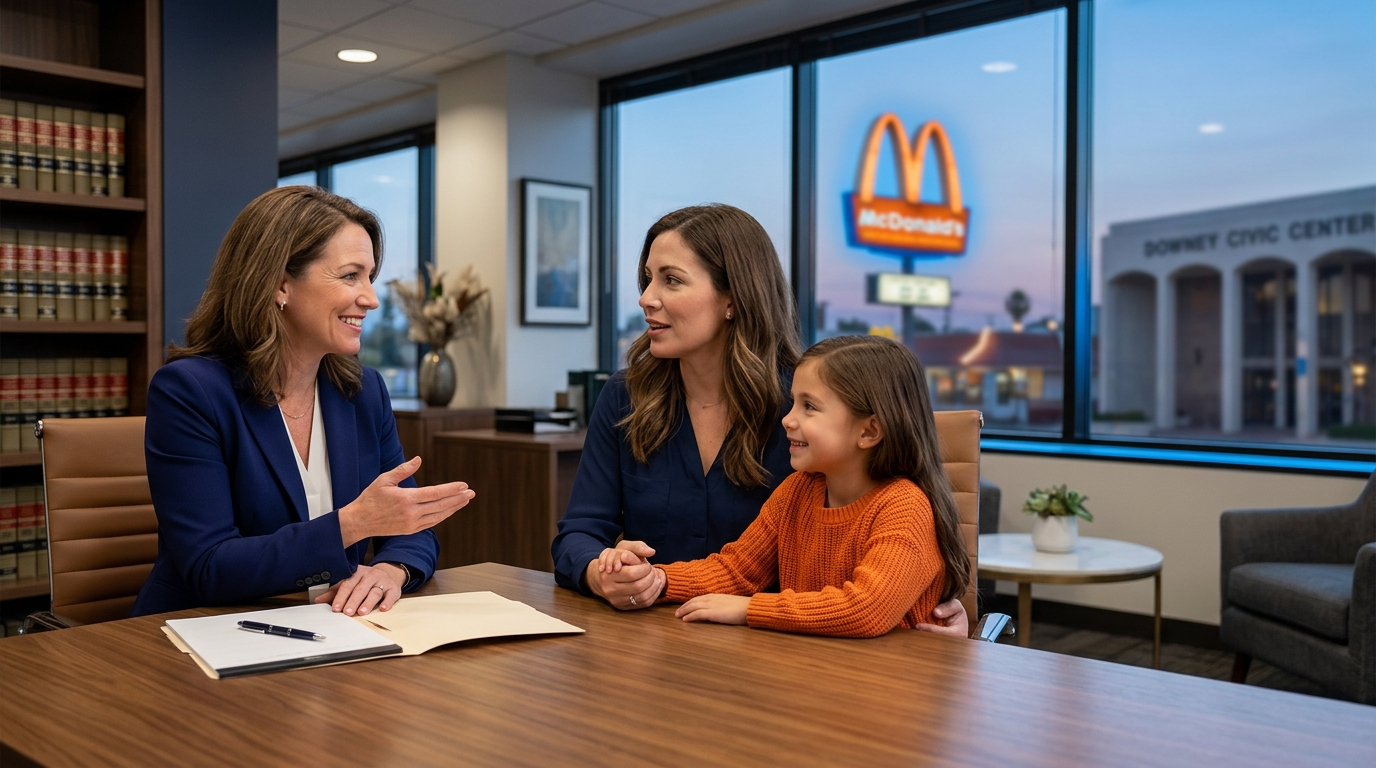
California Child Custody: The Ultimate Guide to Navigating Family Court
Facing a divorce with kids in Downey is terrifying, especially when dealing with the complexities of california child custody. Suddenly, a judge has the power to dictate when you see your children. However, you do not have to let fear control your future. California family law is complex. Still, understanding the rules gives you the power to fight back.
As a family attorney, I see parents lose time with their kids daily. Often, this happens simply because they did not know their rights. Therefore, I am sharing the top seven secrets to navigating the family court system. By learning these facts, you can protect your relationship with your children.
In this guide, we will reveal exactly how custody decisions are made. Let us look at what you must know to win your case and secure your family’s future.
Table of Contents
- Secret 1: Legal Custody vs. Physical Custody
- Secret 2: Mothers Do Not Get Automatic Preference
- Secret 3: Joint Custody is the Goal
- Secret 4: The “Best Interest” Standard Controls Everything
- Secret 5: Custody Mediation is Mandatory
- Secret 6: Status Quo Matters
- Secret 7: Child Support is Tied to Visitation Rights
- Common California Custody Schedules
- The California Child Custody Timeline
- Frequently Asked Questions
Secret 1: Legal Custody vs. Physical Custody
First, you must understand the two primary forms of california child custody recognized in California. These are legal custody and physical custody. According to a 2026 report by J. Carroll Law, these terms mean very different things.
Legal custody gives a parent the right to make major life decisions. These decisions include schooling, medical care, and religious upbringing. On the other hand, physical custody refers to where the child actually lives.
Secret 2: Mothers Do Not Get Automatic Preference
Many fathers walk into my Downey office believing they have already lost. They assume the family court will automatically favor the mother. However, this is a dangerous myth. Under California law, both parents have an equal statutory right to custody.
Furthermore, a father’s rights in a California divorce are not fixed. Instead, they vary depending on each unique family situation and relationship dynamics. As of 2026, judges strictly prohibit gender bias in custody rulings.
Therefore, fathers who actively participate in their children’s lives have an excellent chance in california child custody disputes. You must simply prove that your involvement benefits your child.
Secret 3: Joint Custody is the Goal
Additionally, California courts strongly prefer joint custody arrangements. Judges want both parents to remain active in the child’s life. If you want sole physical custody, you must prove the other parent is unfit.
Otherwise, expect the court to push for a shared schedule. If you need help protecting your assets during this fight, read our guide on community property in California.
Secret 4: The “Best Interest” Standard Controls Everything
Ultimately, all judicial custody decisions must prioritize the best interest of the child. This rule is absolute. According to a September 5, 2025 update from DivorceNet, judges ignore personal disputes with your ex. Instead, they focus entirely on the child’s health, safety, and welfare.
When it comes to california child custody, decisions take into account several factors to minimize disruption to the child’s life. These factors include parental income, living arrangements, and the established relationship with each parent.
Therefore, your legal strategy must always highlight how your requests benefit your child. For more details, check out our post on understanding child custody in California.

Secret 5: Custody Mediation is Mandatory
Before you ever see a judge for a trial, you must attend mediation. California courts strongly encourage parents to resolve custody disagreements outside of court. If you cannot agree independently, you will be ordered to attend california child custody mediation.
Many Downey parents feel terrified of the mediation room. However, preparation is your best weapon. The mediator will try to help you draft a parenting plan. Therefore, you must treat mediation like a job interview.
Be reasonable, stay calm, and focus on your child. Discover more secrets about california child custody mediation to prepare yourself.
Secret 6: Status Quo Matters
Finally, judges love stability. If you move out of the family home and leave your kids behind, you risk everything. This action establishes a “status quo” that favors your ex. Never make major moves without consulting a family attorney first.
Secret 7: Child Support is Tied to Visitation Rights
Many parents do not realize how closely california child custody time and child support are linked. As of 2026, California uses a strict algebraic formula to calculate child support. This formula relies heavily on two factors.
First, it looks at each parent’s income. Second, it calculates the exact percentage of time each parent spends with the child. According to 2025 state data, parents with equal visitation rights often see reduced support obligations.
Conversely, if you waive your visitation rights, your financial burden will likely increase. Therefore, fighting for your rightful time protects your financial future. You must track your parenting time accurately to ensure fair calculations.
Common California Custody Schedules
To help you visualize your options, we outlined the most popular california child custody schedules. These are widely used in California family courts as of 2026. Choosing the right schedule depends entirely on your child’s age and your work flexibility.
| Schedule Type | How It Works | Best For |
|---|---|---|
| 2-2-3 Schedule | 2 days Parent A, 2 days Parent B, 3 days Parent A (rotates weekly). | Younger children who need frequent contact with both parents. |
| Alternating Weeks | 7 days with Parent A, then 7 days with Parent B. | Older children and teenagers who prefer fewer transitions. |
| 3-4-4-3 Schedule | 3 days Parent A, 4 days Parent B, then 4 days Parent A, 3 days Parent B. | Parents with consistent, predictable work schedules. |
The California Child Custody Timeline
Navigating family court requires a clear roadmap. The infographic described below maps out the standard california child custody timeline. It tracks the process from the initial filing to the final order.

First, the process begins when one parent files a Request for Order (RFO). Next, the court schedules a mandatory mediation session. If parents reach an agreement during mediation, the judge signs it into a binding order.
However, if mediation fails, the case proceeds to a court hearing. Finally, the judge reviews all evidence. Then, they issue a final custody and visitation order based on the child’s best interest.
Protect Your Parental Rights Today
In conclusion, navigating a divorce with kids does not have to end in disaster. By understanding these secrets of california child custody, you can approach family court with confidence. Keep these key takeaways in mind:
- Legal custody and physical custody serve different legal purposes.
- Fathers have equal parental rights under California law.
- The child’s best interest is the court’s top priority.
Do not face this stressful process alone. A single mistake in mediation can impact your family for years. Therefore, you need an aggressive, experienced family attorney in Downey to protect your rights.
If you are ready to fight for your children, contact our office today. We offer strategic consultations to help you win. Let us help you secure the future you and your children deserve.
Frequently Asked Questions About California Custody
Here are the most common questions parents ask about california child custody laws and court procedures.
Need help navigating through rough times?
At what age can a child choose which parent to live with in California?
In California, a child cannot legally make the final choice until they turn 18. However, under California Family Code Section 3042, if a child is 14 years or older, the court must consider their preference. The judge still retains final authority based on the child’s best interest.
Can I move out of state with my child after a divorce?
Moving away with a child is highly complex. If you have joint physical custody, you cannot relocate the child out of state without the other parent’s written consent or a court order. The court will evaluate the move strictly using the best interest of the child standard.
What happens if the other parent violates the custody order?
If your ex-spouse refuses to follow the court-ordered visitation schedule, you can file a contempt of court action. Document every violation meticulously. A judge can enforce the order, modify custody in your favor, or impose fines for severe violations.