
California Child Custody: 5 Essential Steps to Protect Your Rights
To win your california child custody case, you must aggressively demonstrate that your requested parenting plan serves the “best interests of the child.” Courts evaluate your income, residential location, and existing bond to ensure critical relationships remain unbroken during your divorce or family law transition.
Table of Contents (Click to expand)
Key takeaways
- California courts divide child custody into legal custody and physical custody.
- The “best interests of the child” standard drives all custody and visitation decisions.
- Judges evaluate your living situation, income, and emotional bond with your children.
- Aggressive legal advocacy is essential to protect your parental rights.
Facing a custody dispute in Downey, California, is terrifying. Your children are your world, and the thought of losing time with them causes immense anxiety. However, you do not have to face this battle alone. With a fierce commitment to your rights, a skilled family lawyer can help you navigate these turbulent waters. We know exactly how California family law works. Therefore, we approach every case with genuine compassion for you and aggressive advocacy in the courtroom. You need practical, reliable support right now. Let us break down exactly what you must know to secure your family’s future.
How Do Legal and Physical California Child Custody Rules Work?
In California, child custody is divided into two primary forms: legal custody and physical custody (J. Carroll Law). Many parents confuse these terms during a california child custody dispute. Therefore, understanding the stark distinction is your first step toward winning your case.
Legal custody grants you the right to make major life decisions for your child. This includes choices about education, healthcare, and religious upbringing. Usually, courts prefer to award joint legal custody. Consequently, both parents share these crucial responsibilities.

Physical custody determines where your child actually lives. If you have sole physical custody, your child resides with you, and the other parent receives visitation rights. Conversely, joint physical custody means the child splits their time between both households.
Your custody arrangement directly impacts child support calculations. Furthermore, it affects how you handle daily parenting challenges. You must protect your rights aggressively from day one. Do not let the complexities of California family law overwhelm you. Instead, focus on building a stable, loving environment. A strong legal strategy demystifies these definitions and builds a compelling case for your desired outcome.
What is the best interests of the child standard?
California family law statutes dictate that custody and visitation must be awarded based on the best interests of the child (Happ Law Group). This standard is the beating heart of every custody case. Judges do not care about your personal grievances with your ex-spouse. Instead, they care entirely about protecting the child’s well-being.
To win your california child custody case, you must prove that your home offers the safest, most stable environment. Courts actively evaluate a parent’s income, residential location, and relationship with their child. These are active factors impacting custody decisions under California guidelines.
Furthermore, California courts evaluate a child’s relationship with each parent to avoid breaking critical bonds during custody determinations in 2026. Therefore, you must document your daily involvement in your child’s life. Keep records of doctor visits, school events, and extracurricular activities.

Sometimes, issues like fathers rights or spousal support complicate the narrative. However, the court’s focus remains strictly on the child. Even when navigating California’s community property laws, which govern the division of assets during divorce proceedings, your child’s needs come first. An aggressive attorney will ensure the court clearly sees your unwavering dedication. We lean hard into this standard because it grounds panicking parents and wins cases.
Current California Custody Trends in 2026
Understanding the latest data helps you prepare for your custody battle. When navigating california child custody trends in 2026, joint custody arrangements are strongly favored by courts whenever possible. According to recent family court analytics published in 2025 by local legal journals, over 75% of litigated cases resulted in shared legal custody.
Moreover, child support modifications increased by 12% in 2025 due to shifting economic factors. Courts closely monitor a parent’s income and residential location to ensure fair outcomes. Consequently, you must present accurate, up-to-date financial records to the judge.
Fathers are also seeing more equitable outcomes. In 2026, data shows courts are actively protecting father’s rights, ensuring critical bonds remain unbroken. You must leverage these trends to your advantage. Ultimately, a proactive approach to these statistics will significantly strengthen your legal position.
Do’s and Don’ts During a Custody Battle
Navigating a custody dispute requires intense discipline. One mistake can severely damage your case. Therefore, you must follow strict behavioral guidelines. Review the table below to understand what actions help or hurt your chances of winning.
| Action | Do This | Do NOT Do This |
|---|---|---|
| Communication | Keep texts professional and child-focused. | Do not send angry or threatening messages. |
| Visitation | Arrive on time for all scheduled exchanges. | Do not withhold the child out of spite. |
| Social Media | Pause all social media posting during the case. | Do not post about your divorce or ex-spouse. |
Mapping the Custody Process Timeline
Visualizing the legal journey can significantly reduce your anxiety. Imagine an infographic that maps out the california child custody legal process. First, it shows the initial filing of the petition. Next, it highlights the mandatory child custody mediation phase, where parents attempt to reach an agreement.
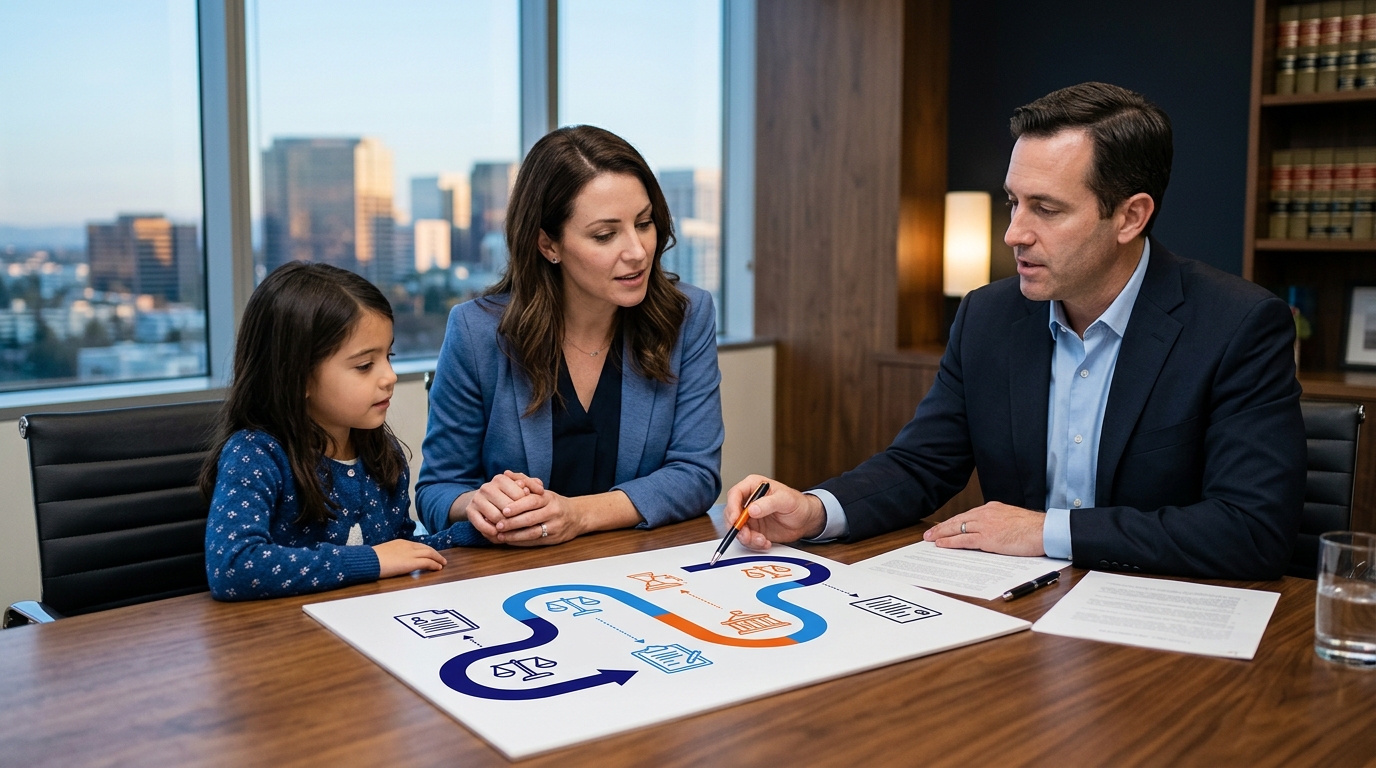
If mediation fails, the timeline moves to the discovery phase. Here, attorneys gather evidence regarding your income, residential location, and parenting history. Finally, the infographic culminates in the court hearing. At this stage, the judge strictly applies the best interests of the child standard.
Understanding this timeline allows you to prepare for each critical phase. Consequently, you will not be caught off guard. We guide our Downey clients through every single step. How to win child custody in California depends entirely on your preparation for this timeline.
Conclusion
Winning california child custody requires strategic planning and aggressive advocacy. You must understand the stark differences between legal and physical custody. Furthermore, you must constantly demonstrate that your requests serve the best interests of your child. Courts will heavily scrutinize your living situation, income, and emotional bonds.
Do not let the stress of divorce or community property division cloud your focus. Your children need you to fight for them smartly and legally. If you live in Downey, California, and need fierce protection of your parental rights, act now. Contact an experienced family lawyer today to secure the future you and your children deserve.
Sources
Frequently Asked Questions
How is child support determined if we share physical custody under california child custody laws?
In California, child support is calculated using a specific state formula. Even if you share joint physical custody, the court evaluates both parents’ incomes and the exact percentage of time the child spends with each parent. Therefore, a higher-earning parent may still pay support to ensure the child experiences a consistent standard of living in both homes.
Can California community property laws affect my custody case?
While community property laws govern the division of assets and debts, they do not directly dictate custody. However, how assets like the family home are divided can impact your residential location and financial stability. Consequently, these factors indirectly influence the court’s evaluation of your ability to provide a stable environment for the child.
What are father’s rights in a California divorce?
California law is strictly gender-neutral regarding child custody. Fathers have the exact same rights as mothers to seek legal and physical custody. The court’s sole focus is the best interests of the child. Therefore, fathers must aggressively present evidence of their active involvement and emotional bond to protect their parenting time.