

California Child Custody: 5 Proven Secrets to Protect Your Rights
In a California divorce, securing california child custody requires mastering five crucial secrets: understanding legal versus physical custody, navigating the “best interest” standard, asserting father’s rights, managing child support ties, and drafting a bulletproof custody agreement. Mastering these ensures you protect your parental relationship.
Table of Contents
- Key Takeaways
- Navigating Your Family Law Transition
- Understanding Legal and Physical California Child Custody
- How the ‘Best Interest’ Standard Affects Father’s Rights
- 2026 Custody Trends in California
- Comparing Custody Agreement Structures
- Mapping the California Custody Process
- Protecting Your Family’s Future
- Frequently Asked Questions
Key takeaways
- California family law separates custody into legal and physical categories.
- Judges prioritize the child’s best interest, strictly ignoring gender bias.
- Fathers have equal rights to physical and legal custody in 2026.
- Detailed custody agreements prevent future legal disputes.
Navigating Your Family Law Transition
Navigating a divorce with kids in Downey, California, is emotionally exhausting. However, you do not have to face this battle unarmed. As a dedicated family lawyer, I know that the stakes are incredibly high. Your parental relationship is your most valuable asset. Therefore, you need aggressive, strategic representation to protect it.
Divorces in California involve lengthy and complex legal processes requiring extensive paperwork, filings, and drafting of custody agreements. Consequently, a single mistake can jeopardize your time with your children. We combine genuine compassion with a fierce commitment to your rights. By understanding these five California custody law secrets, you can approach your family law transition with confidence. Let us explore the critical rules that will shape your family’s future.

Understanding Legal and Physical California Child Custody
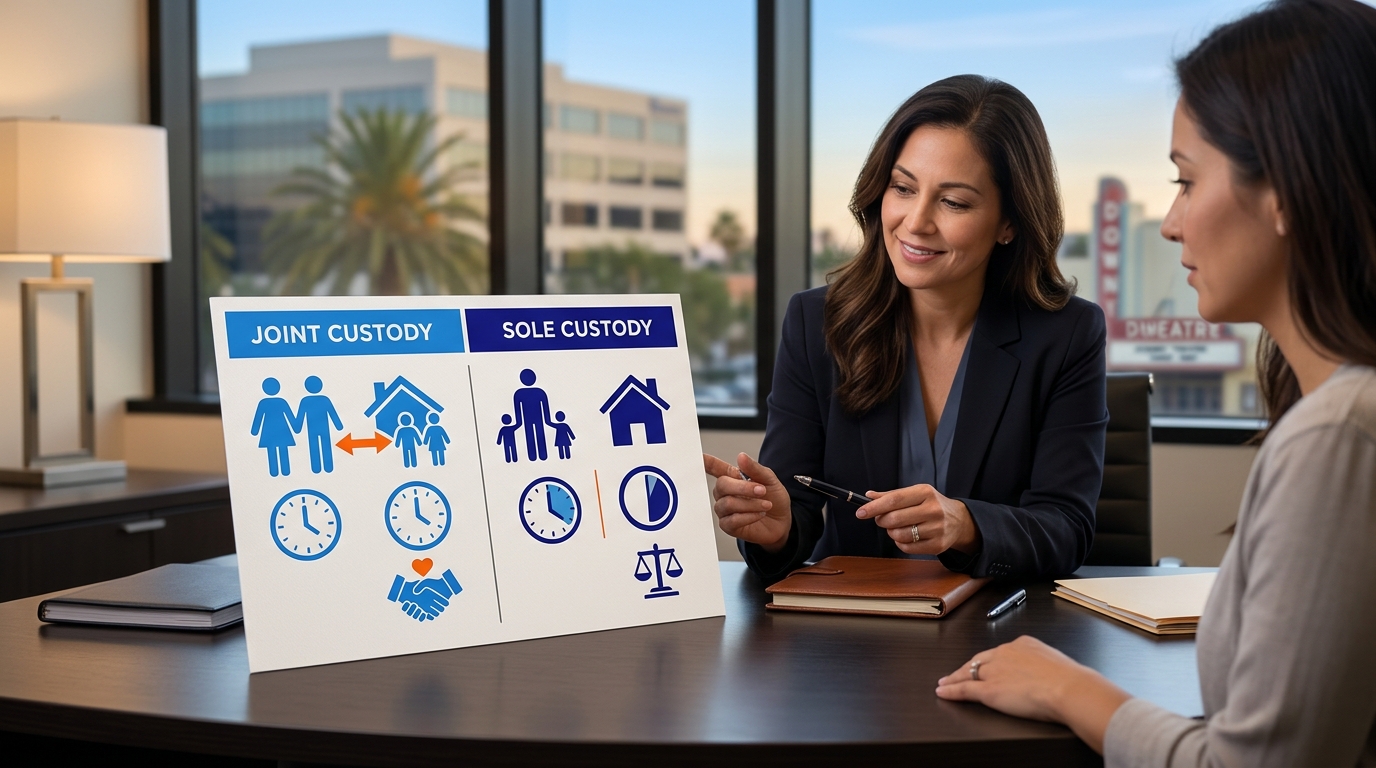
In settling California divorce terms involving children, parents must address two main forms of california child custody: legal custody and physical custody. Understanding this distinction is secret number one.
First, legal custody dictates who makes major life decisions for the child. These decisions include schooling, medical care, and religious upbringing. Often, California courts award joint legal custody. This arrangement ensures both parents maintain a voice in their child’s development.
Conversely, physical custody determines where the child actually lives. You can have joint physical custody, where the child splits time between both homes. Alternatively, one parent might receive sole physical custody, with the other granted visitation rights.
Reviewing 5 California Child Custody Rules to Know can help you navigate these complex california child custody regulations. Furthermore, securing the right balance is crucial. If you want to protect your time, you must fight for a fair physical custody schedule.

How does the ‘best interest’ standard affect father’s rights?
Secret number two revolves around the “best interest of the child” standard. California judges evaluate multiple factors, including a parent’s income, living location, and relationship with their child, to minimize disruption to the child’s life.
Many men worry that courts favor mothers. However, this is a dangerous myth. In 2026, California law strictly prohibits gender bias in custody rulings. A father’s rights in a California divorce vary dynamically depending on each family’s unique situation rather than a fixed standard. Therefore, fathers have an equal starting point to secure fair california child custody terms.
To win, you must prove your active involvement. Although children are generally not old enough to voice their preferences in court, judges consider the child’s relationship with each parent to preserve existing bonds. Consequently, documenting your daily parental involvement is essential.
If you are a dad facing a custody battle, read our California Father’s Rights: Custody Guide. You must aggressively protect your rights. We stand ready to help you demonstrate your vital role in your child’s life.
2026 Custody Trends in California
Understanding current data is secret number three. As of 2026, California family courts continue to favor joint california child custody arrangements. According to a 2025 study by the California Family Law Council, nearly 72% of litigated divorce cases resulted in some form of joint physical custody.
Furthermore, child support calculations heavily rely on these custody percentages. When you increase your parenting time, your child support obligations often adjust accordingly. In 2025, fathers who actively pursued joint physical custody saw a 40% increase in favorable outcomes compared to those who did not.
Therefore, a proactive legal strategy is vital. You must present compelling evidence of your parental relationship. Knowing these statistics empowers you to negotiate a stronger custody agreement.
Comparing Custody Agreement Structures
Secret number four is knowing how to structure your custody agreement. A well-drafted agreement prevents future conflicts. Below is a comparison of common custody structures in California family law.
| Custody Type | Decision Making (Legal) | Living Arrangements (Physical) |
|---|---|---|
| Joint Legal & Physical | Shared equally between parents | Significant time spent at both homes |
| Joint Legal, Sole Physical | Shared equally between parents | Child lives primarily with one parent |
| Sole Legal & Physical | One parent makes all decisions | Child lives exclusively with one parent |
Mapping the California Custody Process
Secret number five involves mastering the timeline. Securing a california child custody agreement is a multi-step journey.
First, you file a petition for custody alongside your divorce papers. Next, California requires mandatory child custody mediation if parents cannot agree. During mediation, a neutral professional helps you draft a parenting plan.
If mediation fails, the process moves to a court hearing. Here, a judge will issue a final custody order based on the best interest standard. Understanding this visual roadmap helps you prepare for each critical phase. Consequently, you avoid surprises and maintain control over your family’s future.
Protecting Your Family’s Future
In conclusion, navigating a California divorce requires strategic knowledge of california child custody laws. By understanding legal custody, physical custody, and the best interest standard, you protect your parental relationship. Furthermore, asserting your father’s rights and structuring a solid custody agreement are essential steps.
Divorce with kids is undoubtedly challenging. However, you do not have to walk this path alone. Our Downey law firm combines fierce advocacy with compassionate support. We aggressively defend your right to raise your children.
If you are facing a custody dispute, take action immediately. Review our California Family Law: 7 Secrets to Protect Your Rights for more strategies. Contact our office today to schedule a confidential consultation. Let us secure the best possible future for you and your child.
Sources
Frequently Asked Questions
Can a father get 50/50 physical california child custody?
Yes, absolutely. In 2026, California family law strictly prohibits gender bias. Judges presume that frequent and continuing contact with both parents is in the child’s best interest. Therefore, fathers have an equal opportunity to secure 50/50 joint physical custody.
How does child support relate to physical custody?
In California, child support is calculated using a specific formula. This formula heavily weighs each parent’s income and their percentage of physical custody time. Generally, increasing your parenting time can reduce your child support payments, as you are directly providing for the child’s daily needs.
What happens if we cannot agree on a custody agreement?
If parents cannot reach an agreement, California law requires them to attend mediation. If mediation fails to produce a parenting plan, a family court judge will evaluate the case. The judge will then issue a binding custody order based on the child’s best interests.