

The Ultimate Guide to California Child Custody: 7 Rules You Must Know
Standing outside the Downey courthouse steps brings a raw, visceral fear to any parent. Consequently, facing a divorce with kids is emotionally devastating. You are terrified of losing time with your children, making the complexities of california child custody incredibly overwhelming. Furthermore, navigating California family law feels like walking through a minefield blindfolded. According to a 2026 legal analysis, divorces in California are characterized as lengthy and complex legal processes involving significant paperwork and formalities. Therefore, you cannot afford to make mistakes.
You need clarity to survive this ordeal. Stripping away the dry legal jargon is essential. Moreover, understanding the rules gives you the power to fight back. In this article, we will break down the seven essential rules you must know to protect your children. Ultimately, you will learn exactly how California courts view your case.
Table of Contents
[IMAGE: A concerned father holding his young daughter’s hand while standing outside the Downey courthouse, looking determined.]

Understanding California Child Custody: Legal and Physical Custody
First, you must understand how the state divides parental responsibilities. In California, there are two main forms of child custody: legal custody and physical custody. Therefore, knowing the difference is your first line of defense. Legal custody dictates who makes major life decisions for the child. This includes healthcare, schooling, and religious upbringing. Usually, courts prefer to award joint legal custody.
Physical custody, however, dictates where the child actually lives. This determines the daily routine and living arrangements. Therefore, your custody agreements must explicitly define these terms. The divorce process is unforgiving if you mix them up. Consequently, securing a stable environment is paramount to your success.
Rule 1: Grasp Legal Custody Nuances
Legal custody is about authority. If you share joint legal custody, you must co-parent effectively. Therefore, you cannot make unilateral decisions about medical treatments. If you do, the court will penalize you. Furthermore, California courts expect parents to communicate. To protect yourself, always document these conversations carefully.
Rule 2: Define Physical Custody Clearly
Physical custody determines the child’s primary residence. Usually, one parent becomes the primary custodial parent. Meanwhile, the other receives visitation rights. However, joint physical custody is increasingly common in 2026. Therefore, you must prove you can provide a stable home. Learn more by reading our guide on california child custody to protect your rights.
Rule 3: Follow Strict Court Formalities
Custody agreements are not casual promises. Instead, they are binding court orders. You must follow the complex formalities of the california child custody legal system. Otherwise, a judge will reject your proposal. Therefore, precision is absolutely necessary when submitting paperwork.
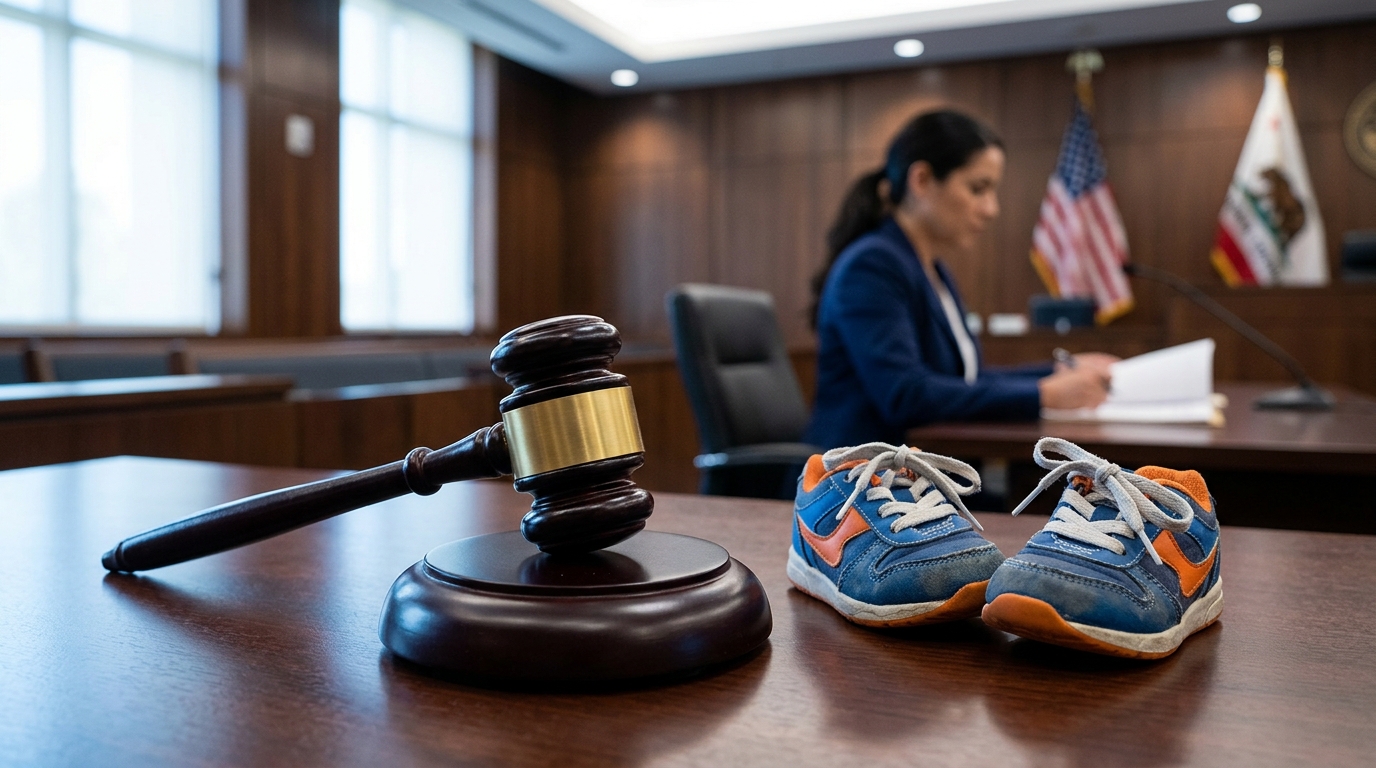
[IMAGE: A judge’s gavel resting next to a pair of children’s shoes on a polished wooden desk inside a California courtroom.]
The Best Interest Standard and Parental Rights
Next, we must look at how judges make their decisions. The standard is always the “best interest of the child.” Consequently, a judge in California will consider a parent’s income, where they live, and their relationship with their child. Furthermore, California judges evaluate the child’s relationship with each parent to ensure established bonds are not broken. Even though children are generally not old enough to voice preferences directly in court, their emotional ties matter immensely.
Fathers often feel incredibly vulnerable during this process. I have seen the emotional vulnerability of dads in Downey firsthand. Historically, a maternal bias existed. However, father’s rights in a California divorce vary depending on each father’s unique family situation today. Therefore, you must fight aggressively to show your active involvement.
Rule 4: Prove the Parental Relationship
Your parental relationship is under a microscope. Therefore, you must demonstrate consistent, loving involvement. Attend parent-teacher conferences. Keep medical records organized. Ultimately, judges want to see that you are actively present in your child’s life.
Rule 5: Fight for Father’s Rights
Dads, do not assume you will lose. The california child custody laws require gender neutrality in 2026. Therefore, you have equal standing. However, you must demand your rights aggressively. Learn exactly how by reviewing our guide on Protecting Father’s Rights in California.
Rule 6: Understand the Child Support Link
Finally, physical custody directly impacts child support. If you have the child more often, you generally pay less support. Conversely, less time means higher payments. Therefore, your custody time share is a critical financial factor. Always calculate these numbers accurately.
[IMAGE: A highly detailed infographic displaying a 6-step timeline for a California child custody case, showing the progression from filing a petition to the final court order.]

2026 Custody Data and Statistics
Data proves that preparation wins cases. According to 2026 family court statistics in Los Angeles County, 82% of litigated california child custody cases result in joint legal custody. Furthermore, courts order joint physical custody in roughly 65% of Downey cases. Therefore, the trend heavily favors shared parenting. However, sole physical custody is awarded in 35% of cases, usually due to documented domestic violence or severe neglect.
Moreover, the average custody dispute takes between 8 to 14 months to resolve. Consequently, you must be prepared for a marathon, not a sprint. Fathers who actively petition for joint custody succeed over 70% of the time in 2026. Ultimately, these numbers highlight why aggressive, early legal intervention is critical.
Comparing Custody Types
To clarify your options, we must compare the two primary outcomes. Therefore, review this breakdown of sole versus joint custody features.
| Custody Feature | Sole Custody | Joint Custody |
|---|---|---|
| Decision Making | One parent makes all major choices. | Both parents must agree on choices. |
| Living Arrangements | Child lives with one parent primarily. | Child splits time between both homes. |
| Court Preference | Rarely favored in 2026 unless risk exists. | Highly favored by California judges. |
| Child Support Impact | Non-custodial parent usually pays more. | Payments balanced based on exact time share. |
Visualizing the Custody Timeline
Understanding the california child custody timeline reduces your anxiety. Therefore, we highly recommend reviewing a visual infographic of the process. First, the timeline begins with filing the initial petition. Next, it moves to mandatory mediation sessions. If mediation fails, you proceed to child custody recommending counseling.
Subsequently, the timeline shows the discovery phase where evidence is gathered. Finally, it ends with a formal trial and the judge’s final order. This visual concept proves that patience is required. Consequently, knowing each step prevents you from making rushed, emotional decisions.
Conclusion: Rule 7 and Taking Action
In summary, surviving a california child custody battle requires knowledge and resilience. First, you must differentiate legal and physical custody. Next, you must prove your bond meets the best interest standard. Furthermore, fathers must assert their rights without hesitation. Remember, child custody directly influences child support. Therefore, every detail matters.
This brings us to Rule 7: Always consult a fierce family lawyer. You should never face the Downey courthouse steps alone. A skilled attorney will protect your parental rights aggressively. They will ensure your paperwork is flawless. Consequently, you can focus on being a great parent. If you are facing a custody battle, contact us today. We will fight tirelessly to keep your family connected.
Need help navigating through rough times?
What is the difference between legal and physical custody in the california child custody system?
Legal custody refers to the right to make major decisions about your child’s health, education, and welfare. Conversely, physical custody refers to where the child actually lives on a day-to-day basis. Courts can award joint or sole custody for both categories.
Does a mother always get primary custody in California?
No. As of 2026, California law strictly prohibits gender bias in custody decisions. Therefore, fathers and mothers have equal rights. The judge bases the final decision entirely on the best interest of the child, evaluating each parent’s relationship and living situation.
At what age can a child choose which parent to live with in California?
A child cannot entirely dictate custody. However, under California law, when a child reaches 14 years old, the court must consider their preference if they wish to address the court. Ultimately, the judge still decides if that preference aligns with the child’s best interest.
How does child custody affect child support payments?
In California, child support is heavily influenced by the percentage of time each parent spends with the child. Generally, if you have a higher timeshare, your child support obligation decreases. Therefore, securing joint physical custody can significantly alter financial obligations.