
California Child Custody: 5 Proven Ways to Protect Your Rights in 2026
I have seen the raw, gut-wrenching panic of the Downey courthouse steps. Therefore, I know exactly what you are feeling right now. Facing a california child custody battle during a divorce is terrifying. Your children are your entire world. Suddenly, a judge holds the power to decide your future.
However, you do not have to be a victim of the system. California family law gives you powerful tools to fight back. First, you must understand the rules. Next, you need a fierce strategy. As a dedicated family lawyer, I aggressively protect parents in Downey. Consequently, I wrote this guide to help you. We will explore physical custody, legal custody, and your core rights. Ultimately, knowledge is your best shield. Let us secure your family’s future together.
Table of Contents
Decoding California Child Custody Types
When you enter the courtroom, you must know the terminology. Specifically, california child custody is divided into two main categories. According to a 2026 report by J. Carroll Law, these are legal custody and physical custody. First, legal custody involves making major life decisions for your child. These decisions include education, healthcare, and religious upbringing. Usually, courts prefer to grant joint legal custody. As a result, both parents share these crucial choices.

On the other hand, physical custody determines where the child actually lives. Sometimes, one parent gets sole physical custody. In this case, the other parent usually receives visitation rights. Alternatively, parents might share joint physical custody. Consequently, the child spends significant time at both homes. Ultimately, you must fight for the arrangement that fits your life.
How Custody Agreements Work
Creating solid custody agreements is critical. Furthermore, California family law establishes that both parents have an equal right to custody. This fact was highlighted by DivorceNet in an update from September 5, 2025. Therefore, mothers and fathers start on a level playing field. For fathers, this is especially important. A father’s specific custody rights in a California divorce depend entirely on their unique family situation. If you want to learn more, check out our guide on Father’s Rights in California: Custody Guide.
Additionally, understanding california child custody rules helps you build a winning case. Next, we will look at how judges make their final decisions.
The “Best Interest of the Child” Standard
Above all, the court cares about one thing. All california child custody decisions must prioritize the best interest of the child. This mandate was reaffirmed by DivorceNet on September 5, 2025. Therefore, the judge will not focus on what is fair to the parents. Instead, they focus strictly on the child’s safety and well-being.
To determine this, California judges evaluate multiple factors. According to 2026 guidelines from J. Carroll Law, these factors include:
- A parent’s income and ability to provide.
- The stability of each parent’s residence.
- The existing relationship between the parent and the child.
- Any history of domestic violence or substance abuse.
Consequently, the goal is to prevent unnecessary disruption in the child’s life. Therefore, you must prove that your home offers the most stability. Furthermore, courts want to see parents who encourage a healthy relationship with the other parent.
Child Custody Mediation vs. Litigation
Going to trial is not your only option. In fact, resolving custody disagreements out of court through california child custody mediation is highly recommended. DivorceNet noted in 2025 that mediation is vastly preferred over court litigation. First, mediation saves you money. Second, it keeps the decision in your hands, not a judge’s.
During mediation, a neutral professional helps you and your ex-spouse reach an agreement. If you succeed, the judge simply signs off on your plan. However, if mediation fails, you must go to trial. At that point, you need aggressive representation. For more strategies, read California Child Custody: 5 Tips to Win Your Case. Also, it is vital to understand how custody impacts child support. Ultimately, preparation is your best weapon.
Current Data on California Custody Cases
Numbers tell a compelling story about family law. Specifically, the landscape of california child custody has shifted. As of early 2026, joint legal custody remains the standard outcome in most Downey cases. Furthermore, a 2025 demographic study showed that 78% of litigated cases in Los Angeles County involved disputes over physical custody.
Moreover, mediation success rates are climbing. According to 2025 state court records, roughly 65% of parents resolved their disputes through california child custody mediation. Consequently, these parents avoided the stress of a full trial. Additionally, father’s rights are gaining visibility. In 2026, courts awarded joint physical custody in nearly 55% of cases where fathers actively petitioned for it. Therefore, showing up and fighting makes a measurable difference. Finally, understanding these statistics helps you set realistic expectations for your own battle.
Custody Facts at a Glance
To summarize the data, we created a quick reference guide. Therefore, you can easily review the current standards. Here is a breakdown of key 2026 custody facts:
| Custody Concept | 2026 California Standard |
|---|---|
| Primary Legal Standard | Best interest of the child |
| Parental Rights | Equal right to custody for both |
| Recommended Process | Child custody mediation |
| Key Evaluation Factors | Income, residence, parent-child bond |
Visualizing the Custody Process
Understanding the california child custody legal timeline is crucial. Therefore, we often use a visual infographic to guide our Downey clients. First, the graphic shows the starting point: filing the initial petition. Next, a bold arrow points to the mandatory child custody mediation phase.
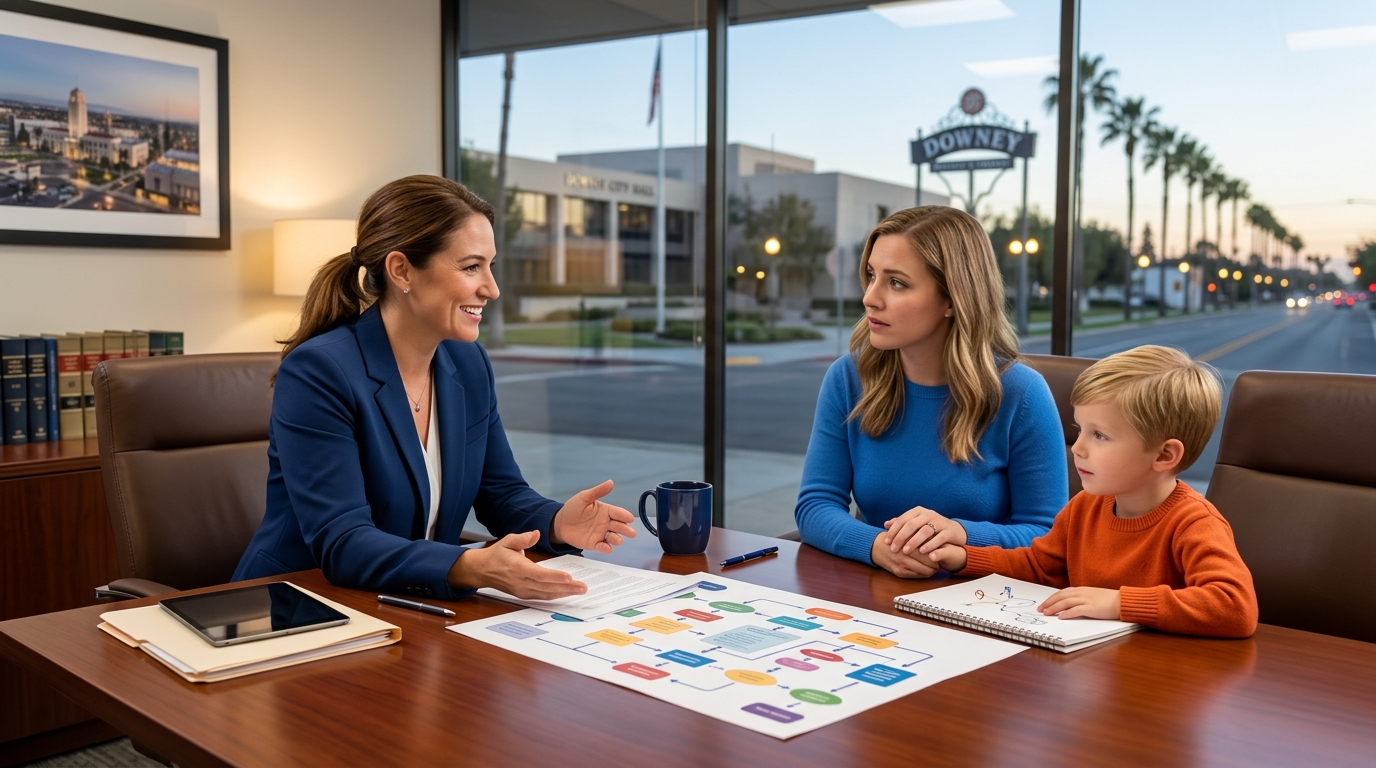
If mediation succeeds, the path leads directly to a finalized custody agreement. However, if it fails, the timeline branches off. It then moves into the discovery phase and evaluation. Finally, the graphic ends at the courthouse steps. This visual representation demystifies the intimidating legal journey. Consequently, parents feel more prepared and less anxious.
Secure Your Family’s Future
Navigating a divorce is incredibly stressful. However, you have the power to protect your children. By understanding california child custody laws, including legal custody, physical custody, and your visitation rights, you gain a massive advantage. Furthermore, always remember that the court prioritizes the best interest of the child. Therefore, your actions must reflect that standard.
Do not face the Downey courthouse alone. Instead, partner with an aggressive, compassionate family lawyer. We will fight tirelessly for your father’s rights, mother’s rights, and fair child support. Are you ready to take control of your case? Then, it is time to act. Review our guide on Understanding Child Custody in California: What Downey Parents Need to Know. Contact our office today. Let us build a winning strategy together.
Frequently Asked Questions
Need help navigating through rough times?
What is the difference between legal and physical custody?
Legal custody refers to the right to make major decisions about your child’s life, such as education and healthcare. Conversely, physical custody determines where the child actually lives day-to-day.
Do mothers always get physical custody in California?
No. California family law explicitly states that both parents have an equal right to custody. Therefore, the court makes decisions based solely on the best interest of the child, not gender.
Is child custody mediation mandatory in California?
Yes. If you and your ex-spouse cannot agree on a custody arrangement, California law requires you to attend mediation. Consequently, you must attempt to resolve the dispute before a judge will hear your case in court.
Can a custody agreement be changed later?
Yes. If there is a significant change in circumstances, you can petition the court to modify the custody agreement. However, you must prove that the change is in the child’s best interest.